Netceed Telecom Belgium Earns Voka Charter for Sustainable Entrepreneurship 2026
The Challenge
As Orange Belgium continues its transition from legacy coax networks to a full fibre network, the challenge was clear: to deploy FTTH efficiently and reliably at scale without repeating the issues experienced elsewhere.
Within Orange Group they had already encountered the limitations of traditional manual street cabinets, including restricted access, too many technicians working on the same infrastructure, limited visibility of who had intervened and when, and an increasing risk of errors.
Orange wanted a different approach for Belgium — one that was smarter, more controlled and future-proof.
The Objective
The project’s goal was to support Orange Belgium’s FTTH rollout with an innovative cabinet solution that would:
- simplify deployment and operations;
- improve visibility and control in the field;
- reduce manual interventions;
- and would also support a scalable fibre network for the future.
In order to remain competitive and provide their customers with high-speed connectivity, Orange required a network that was designed not just for the present, but for the future.
The Solution
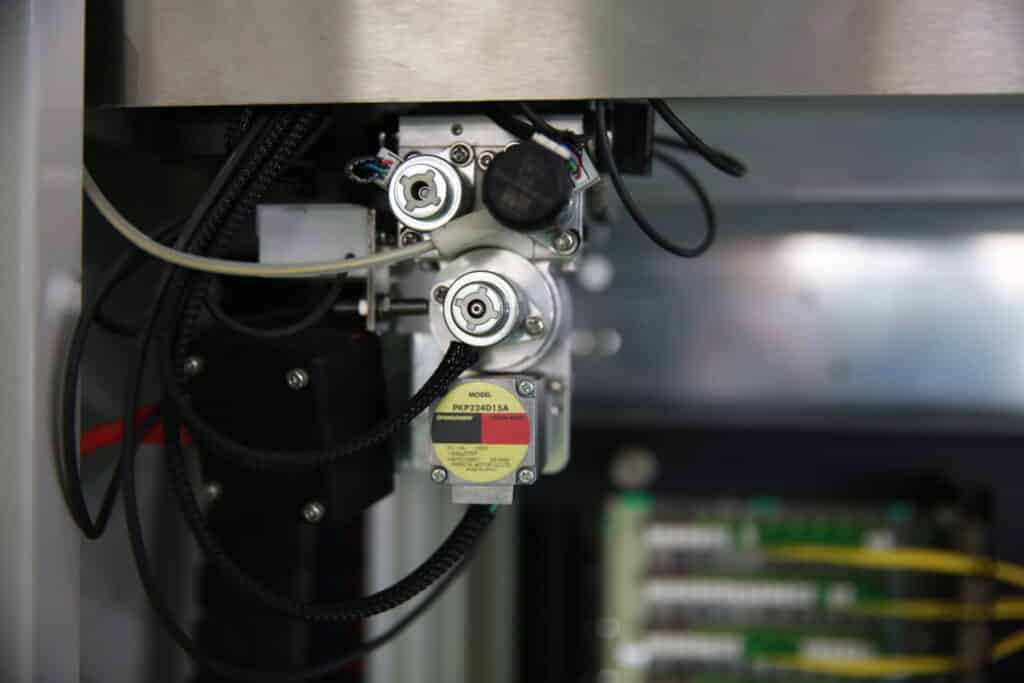
In collaboration with Netceed and Gigacom, Orange Belgium has decided to pilot the use of Automated Service Cabinets (ASCs) in Belgium.
The first phase of the project involved deploying five ASC robots in Ixelles, Brussels. As this technology was new to everyone involved, the initial stage presented challenges ranging from technical adjustments to operational modifications.
Through close collaboration, regular feedback loops and continuous improvements between Orange, Netceed and Gigacom, the solution was quickly stabilised and its performance is increasing.
Due to the positive results, Orange decided to extend the pilot by placing an additional order for 20 robots.
The Impact
The ASC robot project establishes Orange Belgium as a pioneer in automated fibre cabinet management.
The benefits for Orange are clear:
- improved operational control and visibility;
- fewer manual interventions in street cabinets,
- a more secure and scalable FTTH infrastructure,
- and a strong innovation profile within the Orange Group.
What started as a pilot project has become a model for others to follow, with relevance extending far beyond Belgium’s national borders.
Looking ahead
The collaboration between Orange and Netceed has only just begun.
In addition to the expanded deployment of robots, discussions are already underway regarding indoor and outdoor point-of-presence (PoP) solutions, as well as a broader range of products to support Orange’s network expansion, including cables, ducts, manholes, aerial products, and additional infrastructure components.
Netceed’s ambition is clear: to grow as a long-term, trusted partner and support Orange Belgium throughout all phases of its network development.